THE PITCH
London, 1890. You play Lisa Menéndez, a newly appointed detective in the Homicides Police Department with an inherited and deeply inconvenient gift: she can absorb the mental traits of the recently dead. Not their memories, their capacities. Intelligence, empathy, eloquence, nerve.
The brief was to build a game around a crafting system. Rather than crafting swords, Lisa crafts people. Two harvested personality profiles fuse into a new one she can equip, and the personality she wears into a conversation decides which dialogue trees she can even see. Investigation becomes a resource problem: to open the doors this case needs, she has to have taken the right traits off the right corpses.
DESIGN PILLARS
THE PREMISE
The Illuminati are real: an elite of extraordinarily wealthy people with supernatural abilities, who police their own bloodlines to keep those abilities from going mainstream. People being people, mistakes happen.
Lisa's grandmother was one of those mistakes, the child of an affair between an Illuminati and a housemaid, hidden away for fear they would kill her. She inherited one of the most powerful and least convenient abilities in the family catalogue: absorbing the mental traits of the dead.
Lisa's father is a retired mafia boss who acquired his own abilities by killing hundreds of people, and whose past made public life impossible. Wanting something better for his daughter, he raised her on bedtime stories about heroic detectives and steered her toward the police, knowing the job would surround her with fresh bodies to harvest. It would give her the gift without making her a monster like him.
His problem was quality. Criminals, addicts and suicides are, in his view, poor material. So once she was finally accepted into the Homicides Department, he went out and started killing better people for her, engineering a case that would both feed her and test her:
To get him, she'll have to absorb a lot of skills and become an extraordinary person. Then, when she is ready, she will climb the social ladder and become what he could not: famous, rich and powerful, extremely powerful.
The game opens on Lisa's first days in the department. A serial killer starts working, and the first corpse comes with a cryptic message naming her. She is on the case before she understands she is the point of it.
THE LOOP
ASSIMILATION
The core verb. Lisa can absorb the mental traits of a corpse that has been dead for less than 9 hours, 9 minutes and 9 seconds. Miss that window and the material is gone, so some victims are simply found too late. It is the game's one hard constraint, and everything else is built on top of it.
Six traits are harvested, each scored from -50 to +50. A theoretically perfectly average person sits at zero across the board.
Attitude is banded rather than read as a raw number, because how forceful you are reads socially rather than numerically:
CRAFTING A PERSON
Each assimilation yields a Personality Profile. A profile can be equipped on its own, adding its trait modifiers to Lisa's own, or fused with another to produce a Crafted Personality. There are exactly two crafting slots, so a fusion is always a pair, and fusion runs one way only: once a Crafted Personality exists, it cannot be recombined.
Storage is deliberately tight. Lisa carries up to 10 Personality Profiles and up to 5 Crafted Personalities. The scarcity is the design: the player has to commit, compromise and be resourceful with the dead they happened to reach in time.
A CRAFTED PERSONALITY DOESN'T WORK UNTIL YOU'VE SLEPT ON IT.
This is the part that turns crafting into a decision rather than a menu. The moment you fuse two profiles the new personality appears in the Crafted inventory rendered in black and white, and it is inert. Lisa has to rest before it comes online. You cannot stand over a corpse, assemble the perfect interrogator and walk straight into the interview; you have to guess a day ahead of the conversation you think is coming. Once it does activate, it can be dragged into the Favourites slots for quick access.
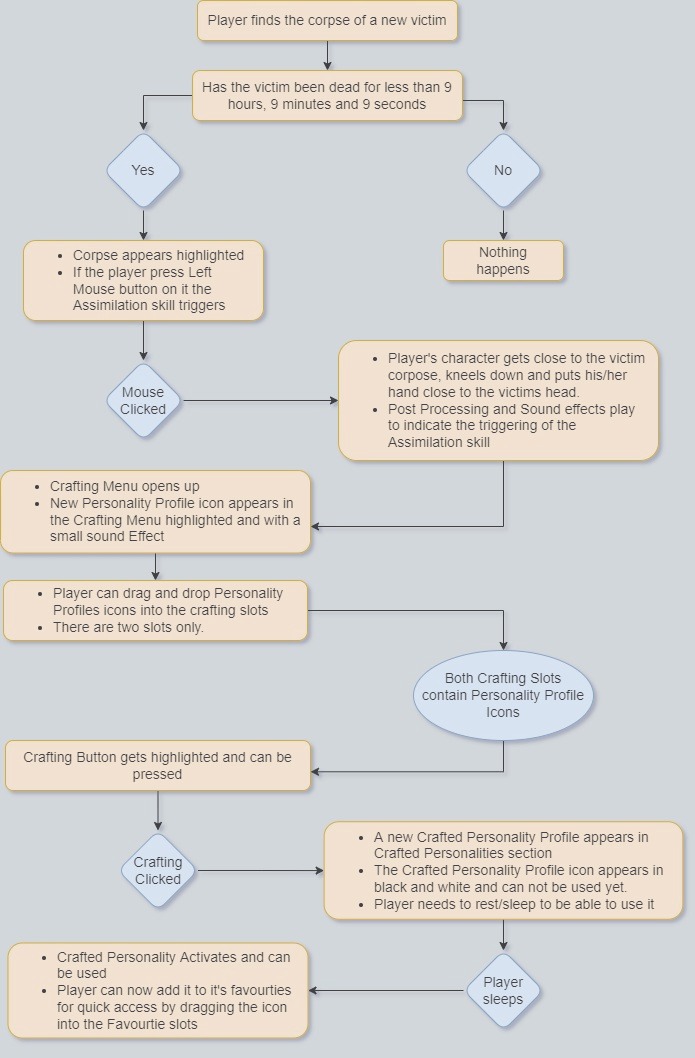
The harvest itself is diegetic rather than a menu action. A viable corpse is highlighted in the world; clicking it sends Lisa to kneel beside the body and place a hand near the victim's head, with post-processing and sound carrying the moment. The crafting menu opens on the new profile, highlighted, and the loop closes.
Sample profiles, showing how sharply specialised a single harvest can be:
DÉJÀ VU POINTS
Conversations are committed. You choose a personality before one starts and cannot swap halfway; you choose a line in the tree and cannot take it back. Every choice counts, which would be unbearable without a release valve.
That valve is the Déjà Vu Point. Spend one and the conversation restarts from the beginning, letting you equip a different personality or walk a different branch with the same one. If the second attempt goes worse than the first, you can undo the déjà vu and return to where you were, permanently closing off that second version.
CLUES AND DIALOGUE TREES
Main Clues are the milestones: they open areas, unlock NPCs and start quest lines. Directional Clues sit between them and point the way, and they come in two flavours, leads that are honest and misleads that are not.
The dialogue trees are where the whole system pays off. Lisa has to raise her stats to unlock the lines that find new clues, so a locked conversation is a design problem rather than a dead end.
Main and side quest dialogue carry distinct visual cues, so the player can choose between pushing the case and going hunting for material.
When a conversation ends with locked content still hidden behind it, Lisa says so out loud, so the player knows to come back better equipped rather than assuming the NPC was a dead end:
"I think he's hiding something." · "She's keeping something for herself." · "I have the feeling that was half of the story." · "Hmmm… is that all?" · "My gut tells me there's more to it."
THE CRAFTING UI
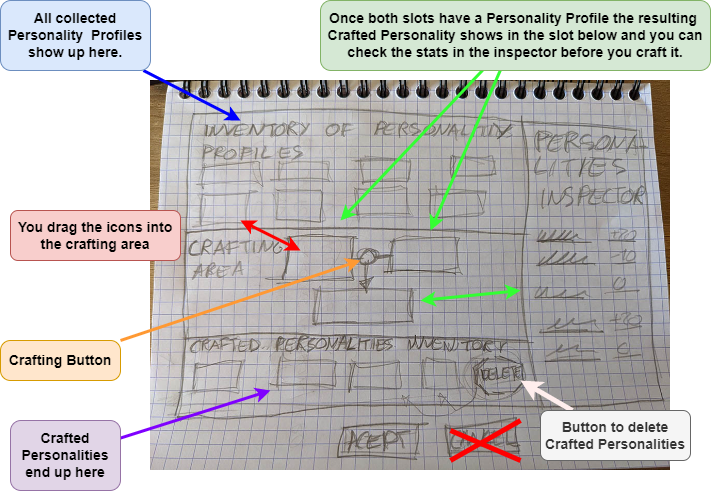
The screen is laid out around the decision it exists to support. Collected profiles line the top, the crafting area sits in the middle, and finished Crafted Personalities collect below. The right-hand column is the important one:
The inspector matters more than it looks. Fusion is irreversible and the result is locked behind a night's sleep, so letting the player read the outcome first is what keeps the mechanic demanding rather than merely punishing.
Reviewing this pass now, the Craft button needs far more presence and probably belongs at the side rather than the middle, and the Cancel button at the bottom is redundant. The overall shape holds up.
WHAT THIS PROJECT WAS FOR
Deadly Smart was a university brief: design a game around a crafting system, and document it to production standard. The interesting part was refusing to read "crafting" as inventory management. Turning it into a social mechanic meant the economy, the progression and the narrative gating all had to be one system rather than three, which is a much harder document to write and a much better game to argue for.
Version 1.2. Design documentation, systems and UI by Ignacio Garcia Zea.